Showing posts with label Egyptian Culture. Show all posts

Sunday, September 11, 2011

The Secrets of Snefru


His name means "bringer of beauty," although he was officially known as the Master of All Justice and Ruler of the Lower and Upper Nile. He was worshipped as a god during his lifetime, some 4,600 years ago, from the Nile Valley to the Sinai. He designed and built the first true pyramids and founded a dynasty--Egypt's 4th--that lasted more than 100 years.
But Snefru, known to the Greeks as "the Good King," has long been overshadowed by "the Bad King," Khufu (also known as Cheops), his more famous son and successor. Because Khufu's Great Pyramid at Giza, on the outskirts of Cairo, is more accessible to tourists, it has become the picture-postcard landmark. Snefru's monuments, by contrast, sat on an army base in Dahshur, 13 miles away. For much of this century, they were concealed behind barbed wire and watch towers, off limits to all but a handful of archaeologists.

Dahshur

Giza

All that will change this week, when Egypt's Supreme Council of Antiquities opens Dahshur's long-hidden monuments to the public, adding a stunning new attraction to the nation's 86 previously accessible pyramids. Eventually, says Zahi Hawass, director of antiquities at Giza, Dahshur could rival Giza as a place of historical interest. "It's time the father became as famous as the son," he maintains. "The father was more important."
The newly opened site encompasses the remains of 11 pyramids, some of which were built 700 years after Snefru's reign, and many smaller rectangular mausoleums, known as mastabas. But it is Snefru's spectacular constructions that dominate the horizon. Most Egyptian kings gave themselves only one pyramid; Snefru built five, three of them at Dahshur.


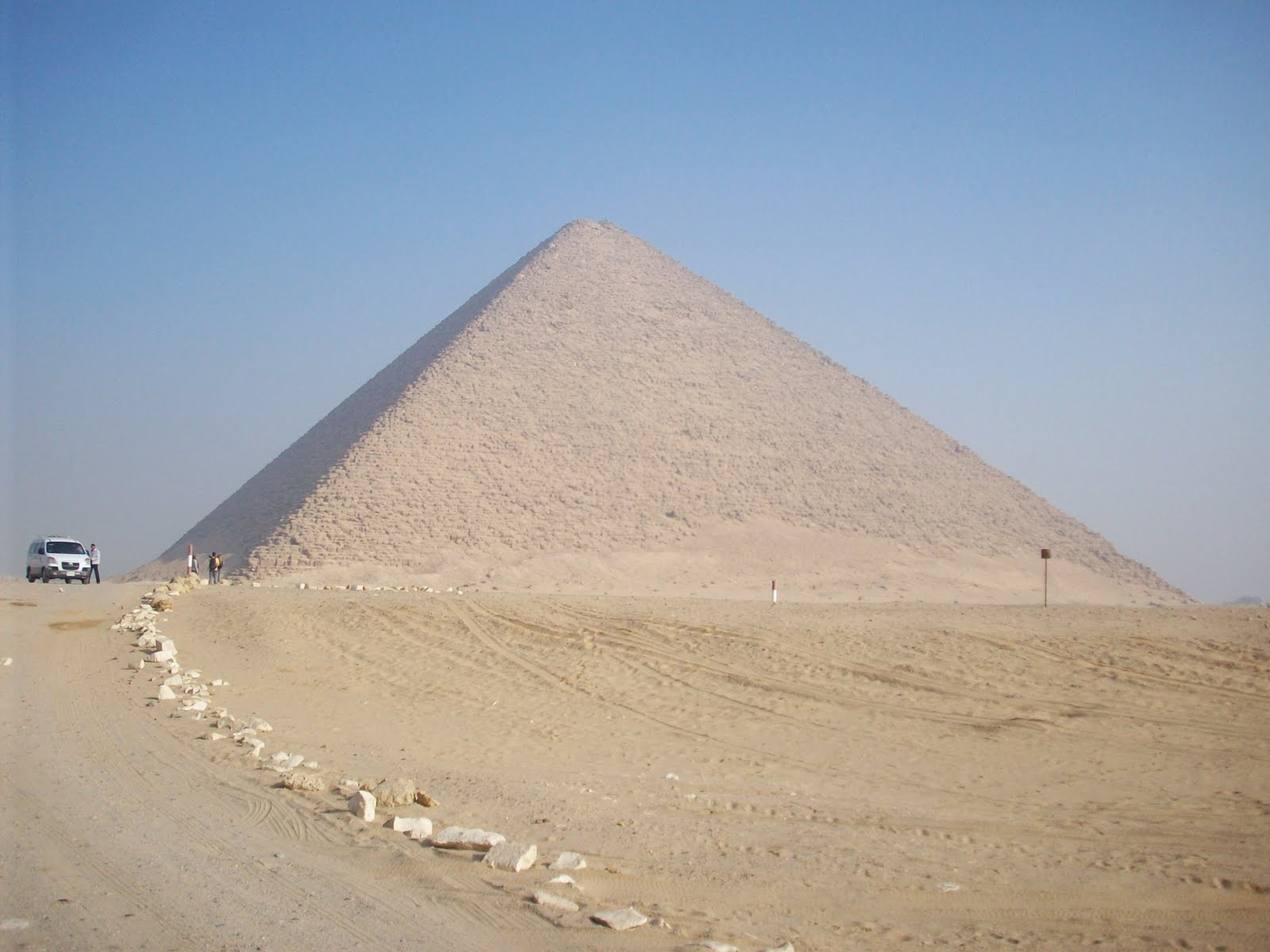
One of the most striking is the Red Pyramid, known by the reddish tinge its iron oxide-rich stone takes on in the light of the setting sun. It is the first pyramid in the classic smooth-sided shape so familiar to schoolchildren. Previously, only step-sided pyramids had been built (a shape that was also seen in Mesopotamia and turned up, much later, in Latin America). It was Snefru who conceived of the more difficult smooth-sided form. "He made the intellectual jump," says Rainer Stadelmann, director of the German Archaeological Institute in Cairo. Enlisting two of his sons as architects, Snefru perfected a system of earthen ramps that allowed his workers to line up the huge stones; when the stones were in place, the earth was removed, revealing the finished pyramid.


Even more intriguing is the so-called Bent Pyramid, instantly recognizable by its strange, blunted profile. It has the best-preserved outer casing of any pyramid in Egypt, perhaps because the lower half of the monument is too steep for stone robbers to scale easily. Viewed from its base, the pyramid rises so abruptly that it seems at first glance to be about to break over visitors like a giant tidal wave.
But halfway up, the angle of incline suddenly changes. Nobody knows why, although archaeologists have argued about it for years. Some theorize that the King may have died during construction, forcing workers to finish quickly. Others suggest that a building disaster--a heavy rain, perhaps--required a change of plans. Stadelmann believes the weak clay beneath the pyramid began to give way; rather than leave an ugly stub, Snefru completed the project at a gentler (and hence more stable) incline and began building the Red Pyramid a mile to the north.


Parts of the Dahshur site were first excavated 101 years ago by French archaeologist Jacques de Morgan, though few visitors ever saw the area. Little was done to build on his work during most of this century, however, and the site fell into neglect. Today Dahshur's pyramids and mastabas are being re-excavated by archaeologists from three countries. "De Morgan's methods were very crude," says Dieter Arnold of New York City's Metropolitan Museum of Art. "He was only interested in treasure and the names of kings."
Treasure he found, in abundance. The jewelry that men and women wore in ancient Egypt was buried with them. De Morgan's finds included two diadems, one with delicately intertwined water weeds and flowers; a necklace of sculpted-gold Nile shells; and an exquisite belt of gold lioness heads and amethyst beads. But De Morgan didn't uncover all there was. A year and a half ago, the Met's Arnold found a Queen's mummy and some of her royal jewelry at one of Dahshur's later monuments. "You're so accustomed to going over robbed tombs that you don't expect to find anything. It hits you like a thunderbolt," he says.


Most of these artifacts date from the 12th dynasty, long after the kingdom once ruled by Snefru disintegrated in an era of famine and unrest. It was during this chaotic period that the first great wave of looting and tomb robbing ruined much of Egypt's historical treasures. The rulers of the Middle Kingdom tried to restore law and order, but the mystical union of nature, religion and state that marked the Old Kingdom never returned.
By all accounts, life was sweet under Snefru's rule. Egypt in the 3rd millennium B.C. was a land of peace and plenty. The nobles feasted on fattened ducks and geese and wore white linen robes--when they wore much at all. One papyrus recounts how a bored King Snefru had himself rowed around a lake by young beauties clothed only in fishnets. Snefru seems to have had an exceedingly high opinion of himself. Until his reign, an Egyptian king was believed to be the earthly incarnation of Horus, the falcon god, achieving full deification only in death. Snefru, however, declared himself to be the living sun god Re. Khufu, following in his father's royal footsteps, took the title Son of the Sun God.


Modern archaeologists downplay the good King--bad King labels, which date to an apocryphal--and now discounted--tale told by the Greek historian Herodotus about how Khufu prostituted his own daughter to pay for his pyramid. Good or bad, Snefru ended up in the Red Pyramid, entombed in a magnificent three-room burial chamber that is considered the finest of the Old Kingdom. The chamber, with its 45-ft. corbel ceiling, remains. Its royal occupant, however, is missing. A mummy discovered in the pyramid in 1948 and believed to contain Snefru's corpse disappeared shortly afterward and has never been found.

Building the Great Pyramid

BBC Documental  Building the Great Pyramid


King Snefru: The Pyramid Builder


The greatest builder of the Pyramid Age was King Snefru, the first king of the Fourth Dynasty, during whose reign the biennial tax levy may have become a more frequent event. As a result, it is difficult to assess the true intensity of Snefru's creative power. He is accorded a reign of 24 or 29 years in the ancient king-lists, yet the recent discovery of an inscription mentioning the twenty-fourth occasion of the census suggests he may have reigned as long as 48 years, if the taxes were still collected every other year. But regardless of his total years, his reign is distinguished by the number and sheer magnitude of the works he carried out. The owner of three full-sized pyramids and probably two smaller ones, he shifted one-third more stone--some 3,600,000 cubic metres (4,708,800 cubic yards) of it than his son and successor Khufu, the builder of the Great Pyramid.


Rahotep and Nofret


Snefru's reign represents an important period in Egyptian history, a period of transition in art and architecture. It was a time when developments in the rendering of the human form and major advances in the working of stone were crystallized and perfected. To him belongs the credit for the first geometrically true pyramids ever attempted in Egypt, as well as major and long-lasting changes in how the resurrection machine functioned. It was his experiments with its conception and form that set the stage for the remarkable achievements at Giza.

The famous pyramid of  Meidum

Previously believed to belong to Huni, simply because no one could conceive of one king building so much, the pyramid at Meidum is now recognized as the first of Snefru's projects. Its bizarre shape, the result of later stone robbing, has earned it the Arabic name 'Haram el Kaddab' or 'The False Pyramid'. It was, however, built--again after several changes of plan--as a step pyramid, the only full-sized one after Djoser's to have been completed. Snefru then decided to try his hand at something completely different.

This pyramid has earned it the Arabic name 'Haram el Kaddab' or 'The False Pyramid'


For his second great project, Snefru chose the previously unused plateau at Dahshur further to the north. He selected the site for his pyramid, now known as the 'Bent Pyramid', for obvious reasons. Here was a large flat area with good-quality stone near by and a gorge that could serve as a natural transport ramp from the Nile. It appeared to be very suitable place to build a new eternal abode of a great ruler. This turned out, however, to be a crucial mistake.


The Pyramid of Dashur


The underlying sands and shales eventually proved unable to support the weight of the pyramid, the first to be designed as a true geometric pyramid and one that would have surpassed the height of the Great Pyramid had it been completed as planned. Although various theories have been proposed to explain the curious change in angle which gives the Bent Pyramid its name, the most convincing reason for its shape was the necessity to remedy the cracks and fissures caused by subsidence which began to appear even while this pyramid was being built.
Dr Rainer Stadelmann, Director of the German Archaeological Institute, has been studying the pyramid for many years to determine exactly what went wrong. As the Bent Pyramid retains more of its original smoothed outer casing blocks than any other pyramid, it is not easy to discern the ancient problems and the methods used to solve them. The best evidence is actually found on the inside of the pyramid within its internal passages and chambers. By studying the cracks and repairs in these areas, Stadelmann has been able to recreate the unfortunate chain of events.


This pyramid is known as the Bent Pyramid

The original plan was to build a true pyramid with a rather steep slope of about 60 degrees, but about half way through construction the outer casing began to crack. To prevent further subsidence, additional masonry was added to all four sides, reducing the angle of inclination to 54 degrees. Yet it was too late. Fissures in the blocks of the completed internal chambers appeared. They tried everything: plaster patches, a new lining of masonry, and even imported cedar logs to shore up the walls.
It was clear that drastic measures were necessary to save the pyramid, the largest monumental building attempted since the beginning of the Egyptian state, but what more could they do? Ultimately, the architects decided that a radical reduction of the angle and a change in the method of laying the masonry were required. The upper half of the pyramid was completed at an angle of 43 degrees to a height of 105 m (344 ft) with smaller stones laid in horizontal rather than inwardly sloping courses to diminish the weight of the mass. Then Snefru started again.


Two and a half miles (4 km) to the north lies Snefru's third pyramid. Called the 'Red Pyramid' after the rusty tinge of the local limestone of its core, it would become Snefru's final resting-place. Quick to learn from their mistakes, this time the king's architects laid a foundation platform of several courses of fine white limestone to prevent the problem of subsidence from recurring. The lesson of the Bent Pyramid also encouraged them to construct the pyramid with stones laid in level, rather than inclined, courses at the similarly modest angle of 43 degrees to a not insubstantial height of 104 m (341 ft), making it the fourth highest pyramid ever built. With its construction, pyramids left the arena of experimentation and finally achieved the distinctive and proper geometric form they would retain until their building ceased.


The beautiful Red Pyramid

The perfection achieved on the exterior of the Red Pyramid is matched by the elegance of its internal chambers. A long descending corridor entered from the north side of the pyramid led to three rooms, over 12 m (40 ft) high and built of enormous limestone blocks. Two connecting chambers were at ground level within the base of the pyramid, but the third was shaped within the masonry of the pyramid itself. It could only be entered via a carefully concealed passage in the wall of the second chamber, some 7.6 m (25 ft) above its floor. According to Rainer Stadelmann, 'With this marvellous sequence of large and high rooms, King Snefru finally had achieved a burial place he could be happy and content with. It was his eternal residence, built with absolute perfection.' The most stunning aspect of these rooms is the corbelled ceilings, the blocks of which were placed in eleven to fourteen layers, each one protruding out over the room about 15 cm (6 in) on all four sides until a pyramid-shaped roof was obtained. In this ingenious way, the weight of the pyramid could be supported. More than two million tonnes of stone rested on these ceilings, yet there are no cracks, no subsidence. Not only had the architects tackled the vexing problems of construction, but by creating a pyramid within a pyramid, they reinforced the king's chances of resurrection.


To celebrate its completion, the proud builders added a solid limestone pyramid-shaped capstone, called today a 'pyramidion'. To the Egyptians, it was the benbenet, the very tip of that mound of creation where the creator god stood when he created the world. Placed on top of these soaring mounds of masonry, it joined the earth with the sky. Few pyramidions from the Pyramid Age survive, possibly because many were gilded with precious metals. The earliest one now known was discovered in fragments around the base of the Red Pyramid. After painstaking restoration, Stadelmann found that each side had a slightly different angle; even with all of their experience in construction, the Egyptians had trouble reaching the top without some readjustments. Such mistakes remind us of the human elements in these austere piles; nevertheless, the error is extraordinarily small--only 2 degrees over 102 m (335 ft), almost 160 courses of stone! Such a minimal readjustment is, in fact, a true testimony to the abilities of Snefru's architects.


To complete such a pyramid in 17 years is an even more impressive feat when one considers that at the same time Snefru was hedging his bets by filling in the steps of the pyramid at Meidum, transforming it too into a geometric pyramid, a shape for which he and his architects deserve full credit. But with this change in shape also came a transformation of the concept of the afterlife and a modification of the complex necessary to ensure it.
The shape and orientation of the pyramid complexes of Snefru's ancestors suggest they looked to the stars, linking their journey to the afterlife with the never-setting circumpolar stars, 'the imperishable ones', as they called them. But while they ascended their staircase to the stellar sphere, Snefru trod a ramp of gleaming white limestone like the sun's rays to heaven. To reinforce this connection Snefru laid out his temples along a new east-west alignment in accordance with the course of the sun. This new emphasis on the sun led to the adoption of an entirely new name, a new manifestation, of the king on his ascension to the throne as the 'Son of Ra', the son of the sun god, a father he would join in the afterlife. Snefru pioneered his new axial design for his resurrection machine at all three of his pyramids, but his son and successors at Giza perfected it.


Perfection in the pyramid building was achieved with the Pyramids of Giza

Sunday, July 10, 2011

The Curse of King Tutankhamun


The tomb of Tutankhamun, a pharaoh, dead at 18 was opened by a team of archeologists on the 17th of February 1923. Led by the Englishmen Howard Carter and Lord Carnarvon, this was one of the most remarkable finds in modern archeology. The seal of the tomb was not broken. Virtually any tomb had been broken into and raided by grave robbers not just once, but twice and thrice through the millennia, but not this one.


   The treasures blinded the men, as gold and fool's gold has always done.


   The most amazing part of it isn't just what happened to the excavation members, but also with others, wo, in various ways encountered the treasure, the curse.
   This is the incredible story following the excavation, the long years of death and suffering, continuing to present day:
   47 days after entering the tomb Lord Carnarvon died painfully on Hotel Continental in Cairo. The cause of death has forever been deemed as unknown, but a mosquito bit him on his cheek, on precisely the same spot where the boy king had a blemish on his skin.


   Arthur Maze, another of the expedition's archeologists, died shortly afterwards, on the same hotel. Carnarvon had just hastily been buried. Maze complained of tiredness and went into coma, never to awaken. If the expedition's medic had a hard time explaining Carnarvon's death, they were completely clueless this time.
   Archibald Reid, the team's radiologist returned to England after complaining of exhaustion. He had just reached English soil when he died.
   George Gould, a close friend of Carnarvon traveled to Egypt when learning of his friend's demise. He visited the tomb, collapsing of high fever and died during the night.

   Carnarvon's personal secretary, Richard Bethell, died of heart failure four months after the breaching of the tomb.
   The old expression "dropping like flies" is truly a significant description of the shocking event following the breaching. More people visited the tomb and died. Within six years after this triumph of modern archeology 12 people present at the time were dead. In 1939, when the last one, Howard Carter died of what was seemingly natural causes only Richard Adamson, the security chief (not present by the breaching) was still alive. Additionally 21 connected in some (often obscure) way with the dig had died. Lord Carnarvon's half-brother committed suicide. The medics claimed temporary insanity as the cause.


   The death toll and number of "accidents" continued to mount during the latter half of the twentieth century. Academics, Egyptologists and others have attempted to ridicule and debunk the curse. To explain "rationally," to explain away the biggest "chain of coincidence" in history. Many of them have themselves fallen victim to the curse.
   Mohammed Ibrahim, Egypt's director of antiquities, died in 1966. He argued, begged Egyptian authorities not to let some of the relics leave the country for an exhibition in Paris. A car ran him down out of the blue while he was stepping out in the streets. Neither the car - nor the driver was ever found.
   Richard Adamson, in 1969 the sole survivor of the monumental expedition voiced his disbelief, his rejection of the curse. His wife died less than 24 hours later. His son barely survived an aircraft crash, but broke his back. Adamson, the old sod, determined not to give in to "superstitious nonsense", gave an interview in British television where he restated his denial.


   Another major chapter was written in 1972 when the precious cargo was flown to London with a Royal Air Force plane. Gamal Mehrez, Ibrahim's successor in Cairo as director of antiquities, ridiculed the curse, claiming that all the deaths and misfortunes throughout the years were "pure coincidence". He died before the plane took off.    The flight's crew members all felt heavily the curse in the years to follow.
   Flight Lieutenant Rick Laurie suffered a heart-attack in 1976 and died, after having complained of "horrible visions and nightmares". The flight engineer, Ken Parkinson lived through a number of heart -attacks. They happened every year during precisely the same time as the flight had commenced, until his final… and fatal one, in 1978. Flight Lieutenant Jim Webb lost everything he owned during a fire. Death and misfortune haunted all the crew-members. One person, after two heart-attacks "confessed" in tears that he had partaken in a poker game on the sarcophagus…
The tumb of Tutankhamun in the Valley of the Kings

When Lord Carnarvon died on 5 April 1923, seven weeks after the official opening of pharaoh Tutankhamun's burial chamber, rumours were rife about a curse.  News of Tutankhamun's tomb and its discoverers had sent the world's media into a frenzy and the death of Lord Carnarvon added another twist for eager journalists.


All sorts of links were found. The lights of Cairo were said to have gone out at the moment of his death (not an uncommon occurrence back then), while back at Carnarvon's English estate his dog, Susie, was supposed to have howled and died at the same time.

Carnarvon's death came just a couple of weeks after a public warning by novelist Mari Corelli that there would be dire consequences for anyone who entered the sealed tomb.  The media and public lapped it up.  Conan Doyle, the creator of Sherlock Holmes and a believer in the occult, announced that Carnarvon's death could have been the result of a "Pharaoh's curse".

One newspaper even printed a curse supposed to have been written in hieroglyphs at the entrance of the tomb, the translation being:
"They who enter this sacred tomb shall swift be visited by wings of death."
However, no inscribed curse was found.
One inscription, found on the Anubis shrine (a jackal on a pedestal shown here) in the tomb's so-called Treasury, did say:
"It is I who hinder the sand from choking the secret chamber. I am for the protection of the deceased."
However, a reporter went on to add his own words to the reported inscription:
"and I will kill all those who cross this threshold into the sacred precincts of the Royal King who lives forever."
Reporting of the curse was further fuelled by more deaths, many with very stretched associations to Tutankhamun. Five months after Carnarvon died, his younger brother died suddenly.
Closer to the tomb, another "casualty" was the pet canary of the tomb's discoverer, Howard Carter. The bird was swallowed by a cobra on the day the tomb was opened.  This was interpreted as retribution for violation of the tomb, particularly as a cobra was depicted on the brow of the pharaoh from where it would spit fire at the king's enemies.

According to one list, of the 26 individuals present at the official opening of the tomb, six had died within a decade. In reality, many of the key individuals associated with the discovery and work on the tomb lived to a ripe old age.
Even when some of the treasures of Tutankhamun went on tour overseas in the 1970s, some people were still of the belief that the curse might be at work. One example was from San Francisco where a policeman guarding Tutankhamun's gold funerary mask tried to claim compensation for a mild stroke based on the effect of the curse. The judge dismissed the claim.
Here is a list of some of the major players involved with the tomb and their fates.
Lord Carnarvon:
Carnarvon had been in poor health for over 20 years following a motoring accident in Germany. Less than two weeks after the official opening of the burial chamber, Carnarvon received a mosquito bite which became infected after he cut it while shaving. Carnarvon fell ill and, with his resistance lowered, came down with pneumonia and eventually passed away at the age of 57.
Howard Carter:
As discoverer of the tomb, Carter should have been Number 1 on the curse's "hit list", but he survived until March 1939, just short of his 65th birthday and nearly 17 years after entering the tomb - about a decade of which was spent working in the tomb itself.
Lady Evelyn Herbert:
Lady Evelyn, Lord Carnarvon's daughter and one of the first into the tomb, died in 1980 at the age of about 79.
Harry Burton:
Burton was the photographer loaned to Carter by New York's Metropolitan Museum of Art to document the work done in Tutankhamun's tomb. Many of the magnificent black & white photographs of the time were taken by Burton who died in 1940.
Alan Gardiner:
Gardiner studied the tomb's inscriptions and was still very active working on Egyptian grammar for many decades until his death in 1963.
Dr D. E. Derry:
Derry carried out the original autopsy on Tutankhamun's mummy. If anyone should have been cursed along with Carter, it probably should have been Derry, but he didn't die until 1969.

The face of Tutankhamun


 Tutankhamun´s Curse Documentary
The Series Egypt